
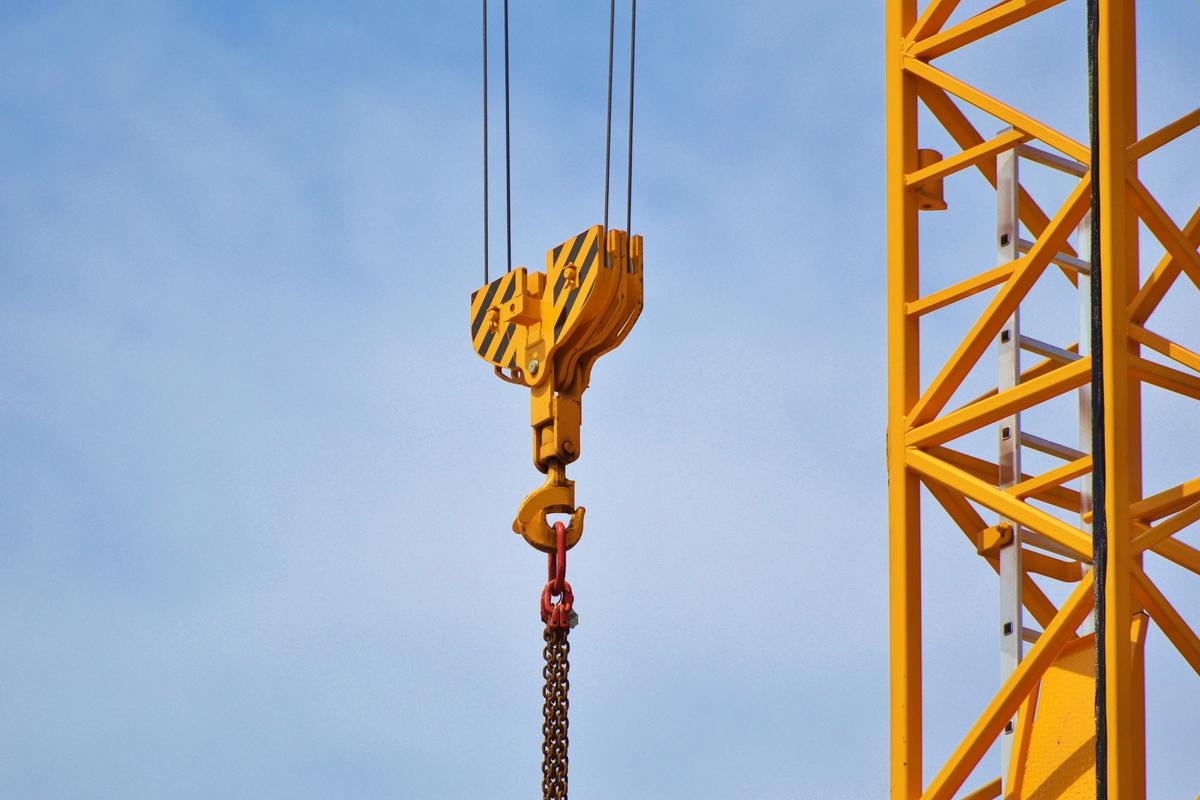
Get your AV-004 diploma for slinging and directing non-critical loads now!
WHAT CAN YOU EXPECT FROM THIS AV-004 RIGGING TRAINING?
For the AV-004 diploma for slinging and directing critical loads, you have come to the right place at Normec Praxis!
The IS and AV diplomas are essential in the petrochemical industry and port companies.
The training can take place at your premises or in one of our partner centres in Flanders.
The number of training days depends on your experience and skills.
If you pass, you receive the official AV-004 diploma!
If your sector or client does not require this specific diploma, then follow our standard training slinging and moving critical loads or slinging and moving non-critical loads.
The aim of this training is the effective and safe hoisting of standard loads.
ADMISSION REQUIREMENTS
- Experience or not? Every hoister of standard loads is welcome in this training!
- Be at least 18 years old
- Identification possible by means of an identity card, passport or driving licence
- Have a declaration of medical fitness
- The participant has command of the language of the examinations
- Normec Praxis pursues an active equal opportunities policy. Our examinations are open to everyone who meets the conditions, regardless of their gender, skin colour or religion
- Examination regulations available on request for in-company trainings
TARGET GROUP
Every employee who, in the course of their daily work, has to sling and hoist loads.
This training is not sufficient for working with specialised equipment. For this, follow the training IS-006 - Slinging and directing critical loads.
OBJECTIVE
Learn to sling and direct loads safely and efficiently.
- Sling and move loads in a correct, responsible and safe manner
- Communicate with the operator of the hoisting device
THEORY ASSESSMENT CRITERIA
The candidate can:
- Indicate which loads are considered non-critical loads
- List the risks involved in slinging and moving loads
- Indicate the applicable legislation and standards
- List and explain the aspects of inspections according to the regulations and according to VCA
- Determine the basic characteristics of the load
- Calculate the forces that occur in the slinging equipment
- Explain the basic concepts relating to the load
- Explain basic concepts relating to lifting accessories and be able to calculate the load in lifting accessories
- Indicate the legally prescribed hand and arm signals
- Explain the use of the different types of slinging equipment and lifting accessories, components and assemblies, their scope of application and their advantages and disadvantages
- Explain the maintenance, inspection and storage of the different types of slinging equipment
- Correctly interpret the data that must appear on the different types of slinging equipment
- Determine how a non-critical load can be safely slung, using various slinging equipment and accessories, according to the nature of the load
- List the various points of attention of the risk analysis during simple hoisting operations with non-critical loads
PRACTICAL ASSESSMENT CRITERIA
- Sling and move a simple construction with an easily determinable centre of gravity
- Correctly sling, move and place on foundation a device with eye bolts
- Guide a load along a course
ACTIONS, NOT WORDS!
- A full day of training lasts 7 hours as standard, unless otherwise stated
- One or more days of tailored practical training
- A lot of experience (1 day) / little experience (2 days) / no experience (3 to 5 days)
- Theory exam + practical exam
- Every successful participant receives the official SLINGING OF NON-CRITICAL LOADS certificate
- The certificate is valid for 5 years and is registered in the Normec Praxis certificate portal
- Every successful participant receives the Besacc-VCA diploma AV-004: slinging and directing non-critical loads
- The diploma is personal and states the high-risk task for which the participant has passed
- The diploma is valid for 5 years and is registered online at http://besacc.epyc.eu/diploma
OTHER HIGH-RISK TASKS
We also organise examinations for the following high-risk tasks:
- IS-001 - Working with forklift advanced
- IS-002 - Working with reach truck advanced
- IS-003 - Working with rigid telehandler
- IS-004 - Working with truck-mounted aerial platform
- IS-005 - Working with self-propelled aerial platform
- IS-006 - Slinging and directing critical loads
- IS-007 - Safety watch confined space
- IS-009 - Working with personal fall protection advanced
- IS-010 - Working on flanges - flange fitter
- IS-011 - Working with overhead crane with cable control / remote control
- IS-012 - Working with overhead crane with cabin control
- IS-013 - Measuring and detecting hazardous substances (EX-OX-TOX)
- IS-031 - Working with rotating telehandler
- IS-032 - Working with rotating telehandler with hoisting function
- IS-081 - Working with independent (autonomous and non-autonomous) respiratory protection
- IS-082 - Working with independent non-autonomous respiratory protection
- AV-001 - Working with forklift basic
- AV-002 - Working with reach truck basic
- AV-003 - Working with scissor lift
- AV-004 - Slinging and directing non-critical loads
- AV-006 - Working with personal fall protection basic
- AV-011 - Fire watch (including: Extinguishing with small extinguishing means (AV-012))
- AV-012 - Extinguishing with small extinguishing means
- AV-013 - Working with mobile crane
- AV-015 - Working with loader crane
- AV-016 - Working with quick-erecting crane up to 10 tonne-metres
- AV-017 - Working with tower crane
- AV-021 - Scaffolding erector
- AV-022 - Scaffolding inspector
WHAT DOES THE LAW SAY?
Mobile work equipment with their own drive may only be operated by workers who have received adequate training for the safe operation of this work equipment (Codex book IV, title 3)
Considered a safety function is any workstation where work equipment is used, where motor vehicles, cranes, overhead cranes, hoisting devices of any kind whatsoever are operated (Codex book I, title 4)
The purpose of safety and health signage is to draw attention, in a quick and easy-to-understand manner, to objects, activities and situations that may cause certain hazards. (Codex book III, title 6, annexes 1-9)